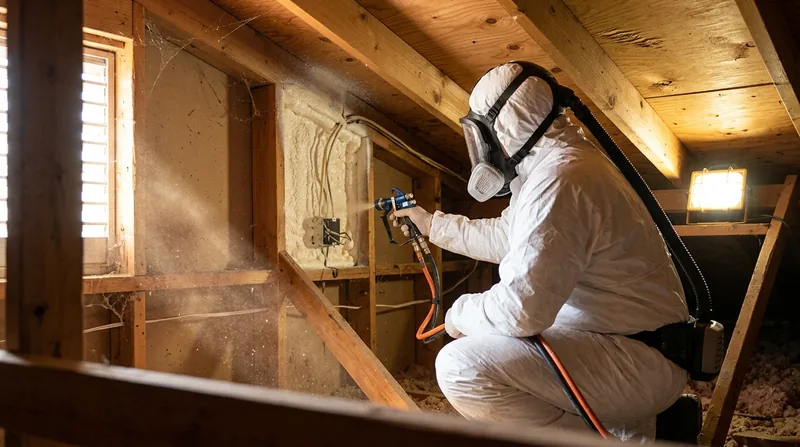




Air sealing in Lubbock stops wind-driven dust and hot air from leaking through gaps around windows, doors, and top plates in brick ranches, student rentals, and newer subdivisions across the South Plains. After a dust storm rolls through Lubbock County, you feel the draft immediately: air finds every crack in the building envelope, coating interiors with fine dust and forcing your air conditioning to work harder all summer long. We seal those gaps with closed-cell spray foam and caulk to cut infiltration at the source, bringing down drafts, dust, and cooling costs in homes from Lubbock to Wolfforth, Shallowater, and Idalou. Unlike blown-in insulation or fiberglass batts, spray foam expands to fill every void, creating an air barrier that stops both conditioned air from escaping and unconditioned air from entering. Air sealing is the single strongest credibility differentiator against generic insulation contractors because it requires precision, local knowledge, and the right equipment. Our approach starts with identifying where air actually leaks in your home, then sealing those paths with materials that last and perform.
Why Air Sealing Matters in Lubbock's Dust and Heat Climate
Lubbock sits on the flat South Plains where wind and dust are part of the landscape. The brick ranches built in the 1950s through 1970s have settled attic insulation and gaps that were never sealed. Newer homes built slab-on-grade with vented attics face the opposite problem: they cool efficiently only if the envelope is tight. Once summer heat climbs above 100 degrees, any air leak becomes an energy leak. Winter cold snaps expose drafts around windows and doors that homeowners ignore until the heating bill arrives. The real enemy here is not humid moisture pushing through walls, it is dust and wind-driven air finding every gap in a wall cavity, around a top plate, or through a rim joist. A single dust storm can deposit fine particles deep inside your walls and attic if the building is not sealed.
- Dust infiltration coats HVAC filters, ductwork, and interior surfaces after every storm, forcing more frequent cleaning and reducing system efficiency.
- Air leaks around top plates and rim joists in older homes account for 15 to 25 percent of total air loss in the building envelope.
- Unsealed window and door frames let hot attic air into living spaces during the cooling season, driving up thermostat setpoints and energy bills.
- Wind-driven rain and dust penetrate brick and frame construction when the air barrier is incomplete, creating interior staining and dust accumulation.
- Ductwork running through vented attics loses conditioned air through leaks and conduction when the attic itself is not sealed from the living space below.
Air sealing stops these failures before they start, protecting your home against the specific climate and building stock of the South Plains.
Key info: A brick ranch in central Lubbock built in 1965 with original blown-in attic insulation and no air sealing will lose an estimated 20 to 30 percent of its cooled air through gaps in the top plate, around window rough openings, and through rim joists. Sealing those paths with spray foam typically reduces air infiltration by 40 to 60 percent and lowers cooling costs by 10 to 20 percent during peak summer months.
For more information on how air sealing fits into a complete insulation strategy, see our attic spray foam insulation service page.
How We Seal Air Leaks in Lubbock Homes and Buildings
Air sealing is not a single step; it is a systematic process of finding, prioritizing, and sealing the leaks that matter most. We start by walking the building with you to identify visible gaps, cracks, and air paths. We look at the attic, crawl space, basement, and rim joists where the structure meets the foundation. We check around windows, doors, electrical outlets, and mechanical penetrations. Once we know where air is leaking, we seal those paths with closed-cell spray foam where the gap is large or irregular, and with caulk or foam sealant where the opening is small or linear. Closed-cell foam is our primary tool because it expands to fill voids completely, stops air and moisture, and provides structural support. The goal is to create a continuous air barrier without gaps or thin spots.
- We inspect the attic floor, rim joists, band joists, and basement rim to identify air leaks at the building envelope perimeter.
- We seal large gaps and voids with closed-cell spray foam applied at the manufacturer-specified thickness and density.
- We caulk linear cracks, gaps around windows and doors, and seams in the top plate with polyurethane or acrylic latex caulk rated for the application.
- We seal electrical and mechanical penetrations where wires, ducts, and pipes pass through the envelope using foam or caulk appropriate to the opening size.
- We verify all seals are complete and continuous before we consider the job finished, and we provide a written estimate detailing what was sealed and why.
The result is a tighter building that stays cooler in summer, warmer in winter, and cleaner year-round because dust cannot find its way inside.
Example: A student rental in the Tech neighborhood near Lubbock had visible dust streaking the interior walls after every dust storm. The brick exterior was sound, but the rim joist was unsealed and the attic floor had gaps where it met the top plate. We sealed the rim with 1.5 inches of closed-cell foam, sealed the top plate gaps with foam, and caulked the window rough openings. After one month and two dust storms, the homeowner reported no new dust streaks and a noticeably quieter interior. The air conditioning also ran less frequently because the building envelope was no longer leaking conditioned air.
Learn more about closed-cell spray foam and its role in air sealing and moisture control.
Air Sealing Methods and Materials
| Method | Description | Best For |
|---|---|---|
| Closed-cell spray foam | Rigid, high-density foam that expands to fill voids completely and provides structural support and moisture resistance. | Large gaps, rim joists, band joists, and areas where moisture or air infiltration is a concern. |
| Polyurethane caulk | Flexible sealant that adheres to wood, concrete, and metal and maintains flexibility as the building moves. | Linear cracks, window and door frames, seams in the top plate, and gaps around penetrations. |
| Acrylic latex caulk | Water-based sealant that is easy to apply and clean up, paintable, and suitable for interior gaps and seams. | Interior cracks, drywall seams, and gaps that do not require structural support or moisture resistance. |
| Foam sealant (low-expansion) | Minimal-expansion foam that fills small voids without displacing adjacent materials or distorting frames. | Gaps around window and door frames, electrical outlets, and mechanical penetrations where precision is required. |
Air Sealing Cost in Lubbock: What to Expect
Air sealing costs depend on the scope of work, the size of the area being sealed, and the materials required. A typical residential air sealing job in Lubbock starts at $650 and increases with the number of penetrations, the linear feet of cracks to seal, and the square footage of rim joist or band joist that needs foam. A brick ranch with a 1,500-square-foot footprint and a vented attic might require 200 to 300 linear feet of rim joist sealing, 50 to 80 linear feet of top plate sealing, and 10 to 15 window and door frame seals. That scope typically runs $1,200 to $2,200 depending on access and the condition of the existing structure. A newer subdivision home with a smaller footprint and fewer penetrations might cost less. A commercial building or a metal structure with extensive ductwork and mechanical penetrations will require an on-site estimate.
The best way to understand what your home will cost is to request a free estimate. We walk the building, identify every air leak, measure the scope, and provide a written estimate with R-value and thickness specifications. We also explain which leaks matter most to your comfort and energy bills, and which ones can be addressed in phases if budget is a concern. Getting 2 to 3 estimates from different contractors is smart because air sealing scope can vary widely depending on how thoroughly the inspector looks for leaks. For detailed pricing information and how different factors affect your cost, see our full pricing overview.
What to Look for When Hiring an Air Sealing Contractor Near Lubbock
Air sealing is a specialized skill that requires knowledge of building science, local climate, and the specific failure modes of houses in Lubbock. When you are comparing contractors, look beyond price and marketing. Ask any contractor how they identify air leaks, what materials they use, and whether they provide a written estimate with specific details about what will be sealed and why. A professional estimate should list the location of each leak, the method of sealing, and the expected outcome. Avoid contractors who give you a vague quote with no breakdown or who promise savings figures they cannot back up. Ask for references from homeowners in Lubbock or nearby towns, and call them to ask about the quality of the work and whether the contractor showed up on time and cleaned up after the job. Verify that the contractor is fully insured and ask to see a certificate of insurance covering general liability and workers compensation. If you have an HOA, check whether the architectural rules require approval for exterior work on rim joists or band joists, though most HOAs do not govern insulation. For any air sealing work that involves disturbing existing insulation or creating new penetrations, confirm with your local building department whether a permit is required at your address. The city or county where you live sets the rules, not the contractor, so call the building department directly if you are unsure.
When you are ready to move forward, contact us for a free estimate. We will walk your home with you, answer your questions, and provide a detailed written proposal with no obligation to book the work.
Air Sealing in Lubbock: Pricing Guide
| Service | Price | Details |
|---|---|---|
| Small residential air seal (rim joist or top plate only) | Starting at $650 | Sealing 100 to 150 linear feet of rim joist or top plate gaps with closed-cell foam and caulk |
| Standard residential air seal (comprehensive) | Starting at $1,200 | Sealing rim joists, band joists, top plate, and 10 to 15 window and door frame penetrations in a typical brick ranch |
| Large or complex residential air seal | Starting at $2,000 | Sealing attic floor, crawl space, multiple mechanical penetrations, or extensive ductwork in larger homes or metal buildings |
| Commercial or metal building air seal | On estimate | Scope and access vary widely; on-site inspection required before pricing is provided to ensure accuracy |
| Travel | Included | No separate charge for travel within Lubbock and surrounding service areas in Lubbock County and beyond |
| Estimate | Free | Written estimate with full scope details provided at no cost; response within 24 hours at (806) 853-5452 |
Indicative pricing, the exact cost depends on square footage, finish, and site access. Free personalized estimate within 24h at (806) 853-5452.


