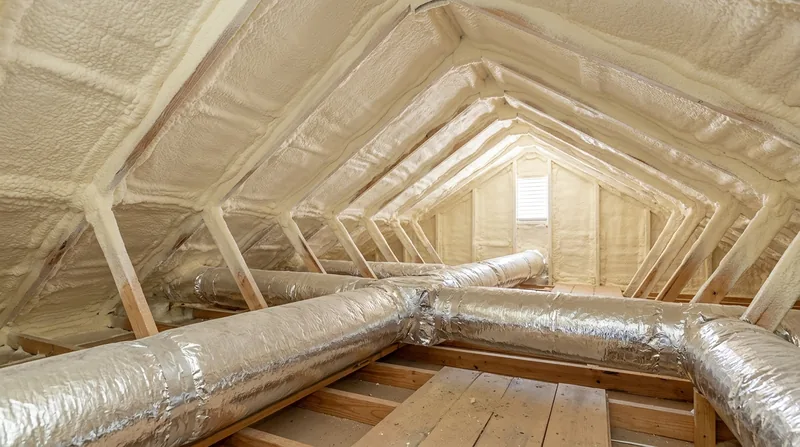




Lubbock's brick ranch homes, built from the 1950s through the 1970s, were insulated to the standards of their era. That original attic fiberglass has settled, compacted, and lost its R-value over decades of South Plains summers that routinely push past 100 degrees. Student rentals near Texas Tech and older frame houses across central Lubbock show the same pattern: thin, deteriorated insulation that lets heat flood in and conditioning dollars pour out. Insulation replacement and re-insulation in Lubbock means removing what no longer works and installing fresh material sized for zone 3B climate, the dry West Texas heat load, and the dust and wind-driven air infiltration that defines this region. We pull out failed or settled insulation and install spray foam or fiberglass that holds its R-value year after year, backed by a written estimate that specifies thickness and performance. The flat terrain of the South Plains and the slab-on-grade construction typical here mean attic access is straightforward, and ductwork running through vented attics that turn into ovens is the dominant cooling load. This is where replacement work pays for itself fastest.
Why Insulation Replacement Matters in Lubbock's Aging Housing Stock
Original insulation in Lubbock homes has a finite life. Fiberglass settles under its own weight, loses density, and stops performing. Older open-cell foam absorbs moisture and deteriorates. Dust storms, common across the South Plains, drive air infiltration through gaps in attics and around rim joists that no amount of old insulation can seal. The result is a home that costs more to cool in summer and heat in winter, ductwork that runs inefficiently through a superheated attic, and indoor air quality compromised by dust ingress. A written estimate with R-value and thickness specifications tells you exactly what you are paying for and what performance you will get.
- Settled fiberglass loses R-value as density drops over 20 to 30 years in a Lubbock attic.
- Dust and wind-driven infiltration bypass thin or failed insulation around rim joists and top plates.
- Vented attics in zone 3B climates turn into radiant ovens that force HVAC equipment to run longer and harder.
- Replacement with spray foam or new fiberglass restores air sealing and thermal resistance in one project.
Replacing insulation is not a luxury upgrade; it is the foundation of energy efficiency and comfort in a Lubbock home.
Key info: Lubbock's dry climate means vapor drive through walls is not the enemy. Heat gain through a thin attic and dust infiltration are. Closed-cell spray foam seals both and holds an R-value of 6.0 per inch indefinitely, while open-cell at 3.6 per inch is the cost-friendly choice for attics where air sealing is the goal. A closed-cell spray foam attic in Shallowater or Wolfforth will drop cooling costs year one and keep delivering.
How We Remove Old Insulation and Install Fresh Material in Lubbock
Replacement starts with removal. We enter the attic, identify what is there (fiberglass, cellulose, old foam, or a mix), and pull it out completely. Partial removal leaves pockets of settled material that compromise the new job. Once the substrate is clean and dry, we inspect for damage, air leaks, and anything that needs repair before we spray. Then we install foam at the specified thickness per pass, maintaining manufacturer ratio and drum temperature, with mechanical ventilation running during cure and a stated re-entry window of 24 to 48 hours. This is not a one-afternoon job with a crew that disappears. It is a measured, documented process.
- We remove all old insulation and dispose of it responsibly, leaving bare decking or framing.
- We inspect the attic for leaks, water damage, air bypasses, and ductwork condition before we spray.
- We seal rim joists, band joists, and top plates where air infiltration enters from outside.
- We install spray foam at the thickness and R-value specified in your estimate, with mechanical ventilation and cure time documented.
The result is an attic that holds its insulation value and stays sealed against dust and heat.
Local example: A 1960s brick ranch in central Lubbock with 3 inches of settled fiberglass in the attic is losing 40 percent of its conditioning to the unconditioned space above. We remove the old material, seal the rim joist and top plate, and spray 5.5 inches of open-cell foam. The homeowner sees a drop in cooling bills within the first summer and air quality improves because the attic is now sealed against dust infiltration. In Levelland or Slaton, the same job on a metal building or agricultural structure is the gateway to metal building spray foam insulation and condensation control.
Insulation Replacement Methods for Lubbock Homes and Buildings
| Approach | Description | Best for |
|---|---|---|
| Open-Cell Spray Foam Replacement | 3.6 R-value per inch, semi-rigid after cure, excellent air sealing, lower cost than closed-cell. | Attics in dry climates where air sealing is the priority and cost matters. |
| Closed-Cell Spray Foam Replacement | 6.0 R-value per inch, rigid, moisture-resistant, high-performance air barrier, longest durability. | Attics, sealed roof decks, crawl spaces, metal buildings, and any zone 3B application where R-value and durability are priorities. |
| Blown-In Fiberglass Replacement | 3.2 to 3.8 R-value per inch depending on density, no air sealing, fast installation, cost-effective for simple attics. | Sound attics with existing fiberglass that need a top-up or replacement where air sealing is not critical. |
| Injection Foam in Closed Walls | Closed-cell foam injected into wall cavities without demolition, seals the cavity, adds R-value to pre-1980 frame construction. | Older Lubbock homes with hollow walls, drafty exteriors, and no interior insulation. |
Insulation Replacement and Re-Insulation Cost in Lubbock: What to Expect
Insulation replacement is priced by the board foot of foam or by the square foot of attic, and the cost depends on the thickness you need, the R-value target, the size of the space, and accessibility. A typical attic replacement in a Lubbock ranch home runs from $2,800 upward. Open-cell foam costs less per board foot than closed-cell, but closed-cell delivers higher R-value and longer durability. Removal of old material adds time and disposal cost but is non-negotiable if you want the new insulation to perform. Travel is included in our service area; we do not charge separate mileage fees to Wolfforth, Shallowater, Slaton, Idalou, Levelland, or Plainview.
The best way to know your cost is to get a written estimate with R-value and thickness specified. We provide that free, with a response within 24 hours. Call (806) 853-5452 or visit our pricing page for a detailed breakdown of what moves the cost up or down.
What to Look for When Hiring an Insulation Replacement Contractor Near Lubbock
Not all insulation contractors are equal. A rig-and-run crew that sprays in an afternoon, promises immediate re-entry, and disappears is a liability. A local contractor with a verifiable address, fully insured coverage, and a written estimate with R-value and thickness is the standard you should expect. Ask any contractor for proof of insurance and the ability to name a local reference. Confirm that your city or county requires contractor registration before work begins, and ask the contractor to show their registration. Some Lubbock neighborhoods and HOAs have architectural rules that govern exterior work on metal buildings or additions; a good contractor will ask about that upfront. Permits for insulation work are rare in most of Greater Lubbock, but contact us if you are unsure what applies at your address.
- Request a written estimate with R-value, thickness in inches, and total board feet clearly stated.
- Ask for proof of full insurance and the name of at least one local reference you can call.
- Verify that the contractor can describe their cure process, including mechanical ventilation and re-entry time.
- Confirm whether your city or county requires contractor registration and ask the contractor to provide it.
- Discuss any HOA architectural rules or permit requirements that may apply to your property.
A contractor who answers these questions directly and without hesitation is one you can trust to do the work right.
Insulation Replacement & Re-Insulation in Lubbock: Pricing Guide
| Service | Price | Details |
|---|---|---|
| Open-Cell Spray Foam Attic Replacement | Starting at $2,800 | Includes removal of old insulation, air sealing, and 5.5 inches of open-cell foam in a typical 1,200 sq ft attic |
| Closed-Cell Spray Foam Attic Replacement | Starting at $4,200 | Includes removal, air sealing, and 5.5 inches of closed-cell foam for superior R-value and durability in zone 3B |
| Blown-In Fiberglass Replacement | Starting at $1,800 | Includes removal of old material and blown-in fiberglass to R-38 or R-49 in attics where air sealing is secondary |
| Injection Foam in Closed Walls | On estimate | Depends on wall cavity size, access points, and total board feet; typically $3,500 to $6,000 for a pre-1980 frame house |
| Travel | Included | No separate mileage or call-out fee for Lubbock, Wolfforth, Shallowater, Slaton, Idalou, Levelland, and surrounding areas |
| Free Estimate | Free | Written estimate with R-value, thickness, and cost within 24 hours; call (806) 853-5452 or contact online |
Indicative pricing, the exact cost depends on square footage, finish, and site access. Free personalized estimate within 24h at (806) 853-5452.


