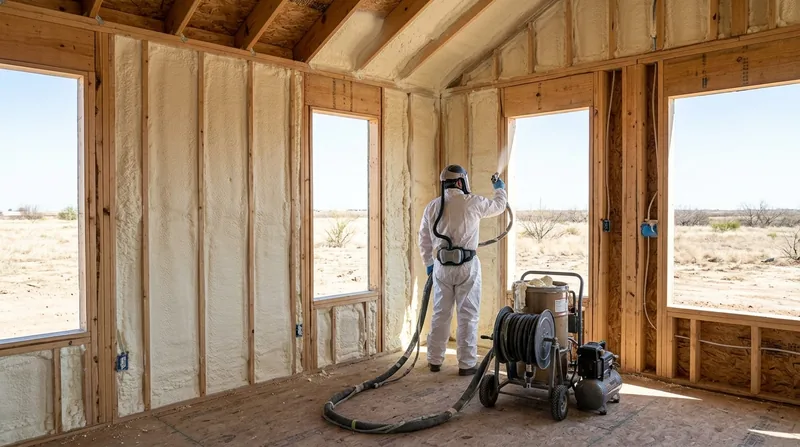




Commercial and new construction spray foam insulation in Lubbock closes the building envelope before drywall goes up, sealing out the dust and summer heat that plague new subdivisions expanding south and west toward Wolfforth and Shallowater. Lubbock sits on the flat South Plains where slab-on-grade construction dominates, and attics in new builds turn into ovens by mid-June if they are left vented and uninsulated. We spray foam new commercial shells and residential framing to IECC climate zone 3B standards, locking in conditioning efficiency from day one and keeping dust and wind-driven air from finding gaps in top plates and rim joists. This is preventive work, not retrofit, and the cost per board foot is lowest when the substrate is clean, dry, and accessible before trades close in the walls. Whether you are building a warehouse in Levelland, a retail shell in Plainview, or a new residential tract in Wolfforth, sealed attics and foam-sealed rim joists pay dividends in the first summer.
Why New Construction Spray Foam Insulation Matters on the South Plains
New builds in Greater Lubbock inherit the climate challenges of the High Plains: extreme summer heat, low humidity, and wind-driven dust that infiltrates every unsealed cavity. A vented attic in a new home can reach 140 degrees in July while the interior sits at 72, forcing air conditioning to run continuously and ductwork to lose conditioned air through leaks before it reaches the living space. Spray foam in new construction seals the building tight, eliminates thermal bypass, and removes the gap where dust and insects find their way inside. Builders who specify closed cell or open cell foam on new framing avoid the settling, compression, and air leakage that plague fiberglass batts by year five.
- We seal attic decks and rim joists before drywall closes in, trapping no moisture and allowing no thermal bypass.
- Closed cell foam provides the R-value per inch needed to control condensation on metal building frames and barndominium steel.
- Open cell foam costs less per board foot and works well for sealed attics where vapor drive is not a concern in zone 3B.
- We verify substrate temperature and humidity before spraying, ensuring the foam cures to full density and adhesion.
New construction is the cleanest application of spray foam because there is no old insulation to remove, no contamination to remediate, and no existing thermal failure to work around.
Key info: Builders in Lubbock and Wolfforth often ask whether to specify closed cell or open cell for a new attic. Closed cell delivers higher R-value per inch and resists moisture on metal roofs or in high-wind zones; open cell is cheaper and works equally well in sealed attics where the interior is conditioned year-round. We help you choose based on your roof assembly and local code.
For detailed permitting and building code requirements in your city, consult your local building department or review the current International Energy Conservation Code (IECC) adopted in your jurisdiction.
How We Spray Foam New Construction and Commercial Shells in Lubbock
New construction spray foam work is staged around the building timeline. We arrive after the roof is dried in and framing is complete but before drywall hangs, electrical rough-in is done, and HVAC ductwork is installed in the attic. We confirm the substrate is clean and dry, check drum temperature and pressure, and apply foam at the thickness and R-value specified in the estimate. Mechanical ventilation runs during application and the cure window, which typically lasts twenty-four to forty-eight hours. Once cured, the foam is inert and ready for trades to resume work.
- We schedule the spray around your construction timeline, coordinating with your GC to avoid conflicts with other trades.
- We apply foam to attic decks, rim and band joists, and any sealed roof assemblies at the thickness and R-value your plans specify.
- We verify curing conditions and mechanical ventilation, then provide written documentation of board footage and density.
- We help navigate local permitting requirements and coordinate inspections if your city or county requires them before drywall closure.
The result is a building envelope that is sealed, insulated, and ready to perform from day one, with no settling, no compression, and no air leakage around rim joists or top plates.
Example: A new residential subdivision in Shallowater specified open cell foam at R-21 on a sealed attic deck, with rim joist sealing on the slab perimeter. We sprayed 1,200 board feet in two days, cured under mechanical ventilation, and the builder closed drywall the following week. The homeowners never deal with attic heat gain or dust infiltration because the envelope was sealed during framing.
For more on how air sealing complements foam insulation, see our air sealing service page.
Commercial and New Construction Spray Foam Methods
| Approach | Description | Best for |
|---|---|---|
| Closed Cell Foam | High-density foam with low permeability, R-6 per inch, superior air sealing and moisture resistance. | Metal building roofs, barndominiums, high-wind zones, condensation control on steel. |
| Open Cell Foam | Lower-density foam, R-3.5 per inch, lower cost, breathable, sound dampening. | Sealed attics in zone 3B where vapor permeability is not a concern, cost-sensitive new builds. |
| Rim and Band Joist Sealing | Spray foam applied to the perimeter band and rim joists on slab-on-grade construction to seal thermal bypass. | All new residential and commercial slab-on-grade construction in Lubbock and surrounding areas. |
| Attic Deck Sealing | Foam applied to the attic deck and top plates of sealed (unvented) attics to eliminate air leakage and thermal bridging. | New residential and commercial buildings with sealed attic assemblies, HVAC ductwork in conditioned space. |
Commercial and New Construction Spray Foam Cost in Lubbock: What to Expect
The cost of commercial and new construction spray foam in Lubbock depends on the size of the attic or sealed roof assembly, the R-value specified, the foam type (closed cell or open cell), and the accessibility of the framing. A free commercial estimate is the starting point, and it includes a site visit, measurement of square footage, verification of substrate conditions, and a written specification of the R-value and thickness we will apply. Most new construction projects in the area range from 800 to 2,000 board feet, with costs driven by foam type and the complexity of the roof assembly.
- Board footage is measured on site after we spray, not estimated in advance, so the final cost reflects what was actually applied.
- Closed cell foam costs more per board foot than open cell but delivers higher R-value per inch and better moisture control on metal roofs.
- Rim joist sealing on a typical slab-on-grade home adds 150 to 300 board feet and is often the most cost-effective energy upgrade in new construction.
- Access, roof pitch, and the presence of obstructions (HVAC ducts, electrical runs, plumbing) affect the time required and the final board footage.
- Multiple estimates from different contractors are wise because specifications, foam type, and application technique vary significantly.
For a detailed breakdown of pricing and what factors move the cost, visit our pricing page or call (806) 853-5452 for a free commercial estimate with no obligation.
What to Look for When Hiring a Spray Foam Contractor Near Lubbock
Hiring a spray foam contractor for new construction is a decision that affects the building's performance for decades. The contractor you choose must understand the local climate (extreme summer heat, low humidity, dust infiltration), the building code in your city or county, and the difference between closed cell and open cell foam. Many contractors are transient, arriving in a trailer and leaving town before the smell fades or the foam fails; the local independent contractor with a Lubbock address, local plates, and a track record in the area is a safer bet.
- Ask any contractor whether they are fully insured and request a certificate of insurance naming your project or company as additional insured.
- Verify that the contractor's city or county registration (if required at your address) is current by contacting your local building department directly.
- Request a written estimate that specifies the R-value, thickness per pass, foam type, and total board footage, not just a price per square foot.
- Ask about mechanical ventilation during cure, the re-entry window, and how they verify curing conditions before closing the building.
- Call at least two other contractors and compare specifications, not just price; the cheapest bid is often the one with the lowest R-value or the thinnest application.
- Check references from at least two completed new construction projects in Lubbock, Wolfforth, or Shallowater and ask the builder whether the foam stayed in place and performed as specified.
The best contractors are the ones who walk away from a job if the substrate is wet, contaminated, or not ready, because they know a bad installation will follow them and cost them credibility. Contact us at our contact page or call (806) 853-5452 to discuss your new construction project and schedule a free estimate.
Commercial & New Construction Spray Foam in Lubbock: Pricing Guide
| Service | Price | Details |
|---|---|---|
| Free Commercial Estimate | Free | Site visit, measurements, substrate assessment, written specification with R-value and thickness |
| Open Cell Foam (New Construction) | Starting at $0.65 per board foot | Typical range for sealed attics and rim joists, final cost depends on accessibility and thickness |
| Closed Cell Foam (New Construction) | Starting at $1.10 per board foot | Higher R-value per inch, condensation control on metal roofs, final cost based on board footage applied |
| Complete New Build Envelope Sealing | On estimate | Attic deck, rim joists, sealed roof assemblies, and air sealing package requires on-site assessment |
| Travel and Scheduling | Included | No mileage fee or travel charge in Lubbock and surrounding service areas |
| Estimate Response | Free | Response within 24 hours at (806) 853-5452, no obligation to book |
Indicative pricing, the exact cost depends on square footage, finish, and site access. Free personalized estimate within 24h at (806) 853-5452.


