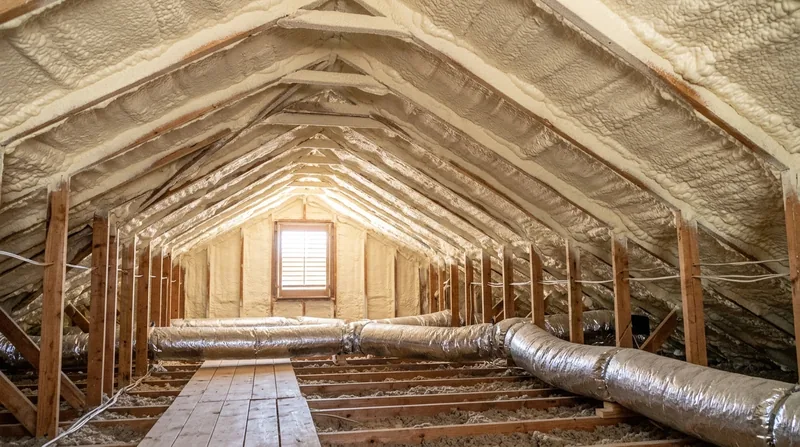




Attic spray foam insulation in Lubbock stops the heat that turns your attic into a furnace every summer. Lubbock sits on the flat South Plains where vented attics routinely exceed 100 degrees, baking ductwork and driving cooling costs skyward from June through September. The brick ranches built across central Lubbock in the 1950s and 1970s still carry original fiberglass that has settled thin over decades. Student rentals near Texas Tech leak conditioned air through gaps around windows and doors. New subdivisions spreading south toward Wolfforth and Shallowater sit slab-on-grade with HVAC ductwork running through vented attics that suffer the same heat penalty. Wind-driven dust from the South Plains finds every gap in top plates and wall cavities after dust storms roll through. Sealing your attic under the roof deck with spray foam stops that heat gain, seals against dust infiltration, and protects your ductwork from the temperature swings that shorten its life.
Why Attic Spray Foam Insulation Matters in Lubbock's Heat and Dust Climate
Lubbock's summer heat and year-round dust load create a dual problem that fiberglass insulation cannot solve. A vented attic in July reaches temperatures that damage ductwork seals and force air conditioning systems to run longer just to overcome the attic heat load. Fiberglass settled thin in older homes offers almost no resistance to that radiant heat. Dust storms that blow through the South Plains drive fine particles into every unsealed gap, contaminating ductwork and reducing airflow efficiency. Spray foam under the roof deck seals the building envelope completely, stops the radiant heat before it reaches your living space, and eliminates the dust infiltration that plagues older construction.
- Seals the entire attic cavity to stop 100-degree summer heat from radiating down into conditioned space.
- Closes gaps around top plates, rim joists, and penetrations where wind-driven dust enters year-round.
- Protects ductwork from temperature extremes that degrade seals and reduce system efficiency.
- Reduces cooling load during peak summer demand when electricity costs spike.
- Maintains consistent indoor temperature by eliminating convective air movement through the attic.
These five factors combine to make attic spray foam the single most effective insulation upgrade for Lubbock homes and the surrounding South Plains region.
Key info: Brick ranches in central Lubbock and frame houses near Texas Tech lose the most energy through undersized or failed attic insulation. A home in Wolfforth or Shallowater with ductwork running through a vented attic can see cooling bills spike 30 to 40 percent during summer if the attic is not sealed. Spray foam stops that loss.
For guidance on whether your attic qualifies for spray foam and what local permits may apply, contact the building department in your city or county. Texas regulates contractors at the municipal level, so requirements vary by location. We help you navigate what applies at your address and work with your local building official to ensure compliance.
How We Spray Foam Your Attic: The Process in Lubbock
Attic spray foam insulation begins with a thorough inspection of your roof deck, rafters, and existing insulation. We identify all air leaks, assess substrate condition, and determine whether the attic is suitable for spray foam or whether old insulation must be removed first. We then outline the R-value and foam thickness needed to meet your goals and local code. Once you approve the estimate, we schedule the work, set up mechanical ventilation during the spray process, and maintain that ventilation for the full cure window. The foam cures in 24 to 48 hours, after which your attic is sealed and insulated.
- We inspect the attic, identify leaks and failed insulation, and write an estimate with R-value and thickness specifications.
- We remove old insulation if it is contaminated, settled thin, or blocking proper foam application.
- We seal all gaps, penetrations, and air leaks in the attic cavity before applying foam.
- We spray closed cell or open cell foam to the thickness and coverage your estimate specifies.
- We provide mechanical ventilation during cure and establish a re-entry window of 24 to 48 hours before the space is occupied.
This step-by-step approach ensures the foam bonds properly to the substrate and cures to full strength without off-gassing issues or incomplete coverage.
Local example: A 1960s brick ranch in central Lubbock with 2,200 square feet of attic space typically requires removal of settled fiberglass, sealing of top plate gaps, and 5 to 6 inches of closed cell foam under the roof deck to achieve an R-value of 30 to 38. A newer subdivision home in Shallowater with an open vented attic and existing fiberglass may need only 3 to 4 inches of foam to top up the insulation and seal the envelope. Our estimate specifies exactly what your home needs.
Learn more about insulation removal and replacement if your attic contains old or failed insulation that must come out before foam is applied.
Closed Cell vs. Open Cell Spray Foam for Lubbock Attics
Closed cell and open cell spray foam serve different purposes in attic insulation. Closed cell foam has a higher R-value per inch (around R-6 to R-7), is moisture-resistant, and provides structural rigidity. Open cell foam is lower cost, lower R-value per inch (around R-3.6), and is softer and more flexible. In Lubbock's dry climate, closed cell is the standard choice for sealed attics because it delivers superior R-value in thinner applications and handles the temperature swings of the South Plains without moisture risk. Open cell makes sense for unconditioned attic spaces or when budget is the primary constraint, but sealed attics under the roof deck almost always call for closed cell.
| Approach | Description | Best for |
|---|---|---|
| Closed Cell Foam | High-density, R-6 to R-7 per inch, moisture-resistant, rigid structure, low vapor permeability. | Sealed attics under roof decks, metal buildings, condensation-prone areas, high R-value in tight spaces. |
| Open Cell Foam | Low-density, R-3.6 per inch, softer and flexible, breathable, lower cost, sound-dampening. | Unconditioned attics, garages, interior walls, projects where R-value per inch is less critical and budget is primary. |
| Blown-In Fiberglass or Cellulose | Traditional loose-fill insulation, no air sealing, settles over time, allows convective air movement. | Topping up existing attic insulation in homes where air sealing is not required and cost is minimal. |
| Injection Foam Retrofit | Closed cell foam injected into existing wall cavities without demolition, seals and insulates in one step. | Older brick ranches with hollow walls, homes where interior or exterior finishes cannot be disturbed. |
For most Lubbock attics, closed cell spray foam is the right answer because it seals the envelope completely and delivers the R-value needed to stop the summer heat load. We assess your specific attic and recommend the approach that fits your goals and budget.
Attic Spray Foam Insulation Cost in Lubbock: What to Expect
Attic spray foam insulation cost in Lubbock typically ranges from $1.50 to $3.00 per square foot of attic floor space, depending on the R-value target, foam type, existing insulation removal, and accessibility. A 2,000-square-foot attic with closed cell foam to R-38 and removal of old insulation generally costs between $3,000 and $6,000. A smaller attic or one requiring only a top-up with open cell foam may run $1,500 to $2,500. The largest variable is whether old insulation must be removed: contaminated fiberglass, settled mineral wool, or failed foam all require disposal before new foam is applied, and that labor and hauling adds 20 to 40 percent to the total.
Other factors that move cost are attic access, roof complexity, the presence of obstacles like HVAC ducts or plumbing, and the thickness of foam required to achieve your target R-value. An attic with tight access or complex roof framing takes longer to spray. An attic with extensive ductwork or mechanical systems requires more careful planning and masking.
The best way to know your actual cost is to request a free, no-obligation estimate. We inspect your attic on site, measure the space, assess what must be removed or sealed, and provide a written estimate with R-value and thickness specifications. That estimate is your baseline for comparing quotes and understanding what the work includes. Call us at (806) 853-5452 or visit our pricing page for a detailed breakdown of costs by service type.
Why estimates vary: Two homes with identical attic square footage may have very different costs because one requires full insulation removal and the other does not, or one has complex roof geometry and the other is straightforward. Never compare prices across contractors without confirming what each estimate includes: R-value, thickness, removal or top-up, ventilation during cure, and the warranty on workmanship. A price far below market with no detail on R-value or thickness is a sign that the job is not being properly scoped.
Attic Spray Foam Insulation Near Me: What Lubbock Homeowners Should Know When Hiring
Hiring a spray foam insulation contractor is one of the larger home improvement decisions you will make, and it pays to be deliberate. The spray foam trade attracts both local independents who stand behind their work and rig-and-run outfits that spray in an afternoon and disappear when the smell lingers or the foam does not cure properly. Start by asking any contractor for proof of insurance, including general liability and workers compensation. Verify that they carry current coverage and that the policy is active at the time of work. Ask for references from recent attic jobs in Lubbock, Wolfforth, Shallowater, or Idalou, and contact at least two homeowners to ask about their experience and whether they would hire the same contractor again.
Request written estimates from at least two or three contractors. Each estimate should specify the R-value you are paying for, the foam thickness in inches, whether old insulation is being removed or foam is a top-up, and the warranty on workmanship. Avoid estimates with vague language like "full coverage" or "standard R-value." Ask what mechanical ventilation will be used during cure and what re-entry window the contractor guarantees. Any contractor who promises immediate re-entry or who minimizes the curing process is cutting corners.
Check your city or county building department to understand whether a permit is required for attic spray foam work at your address. Lubbock, Wolfforth, Shallowater, Slaton, Idalou, and other municipalities in the region set their own contractor registration and permitting rules, and there is no reciprocity between cities. Ask your contractor what registration your local building department requires and confirm that they hold it. We are fully insured and help you navigate what applies at your address, but the final responsibility for compliance rests with you and your contractor.
If your home is in a master-planned community or has an HOA, check whether architectural approval is required for any work visible from the street. Attic insulation inside the home is typically not subject to HOA review, but if exterior venting or roof access is involved, confirm the rules beforehand.
For a free estimate and to discuss your attic insulation needs, contact us today or call (806) 853-5452. We respond within 24 hours, answer your questions, and provide a clear written estimate with no obligation to book.
Attic Spray Foam Insulation in Lubbock: Pricing Guide
| Service | Price | Details |
|---|---|---|
| Closed Cell Spray Foam, Sealed Attic | Starting at $2.00/sq ft | 5 to 6 inches under roof deck to R-30 to R-38; includes air sealing and substrate preparation before foam application |
| Open Cell Spray Foam, Attic Top-Up | Starting at $1.50/sq ft | 3 to 4 inches over existing insulation to boost R-value; best for unconditioned or vented attics where cost is primary concern |
| Insulation Removal and Replacement | Starting at $0.50/sq ft removal, plus foam cost | Removal of settled fiberglass, mineral wool, or failed foam; disposal and haul-away included; adds 20 to 40 percent to total project cost |
| Complex Attic or Metal Building | On estimate | Attics with extensive ductwork, complex roof geometry, or tight access require on-site inspection before pricing; call for details |
| Travel and Estimates | Free estimate, no travel fee | Included in Lubbock and surrounding service areas; response within 24 hours at (806) 853-5452; no obligation to book after estimate |
Indicative pricing, the exact cost depends on square footage, finish, and site access. Free personalized estimate within 24h at (806) 853-5452.


