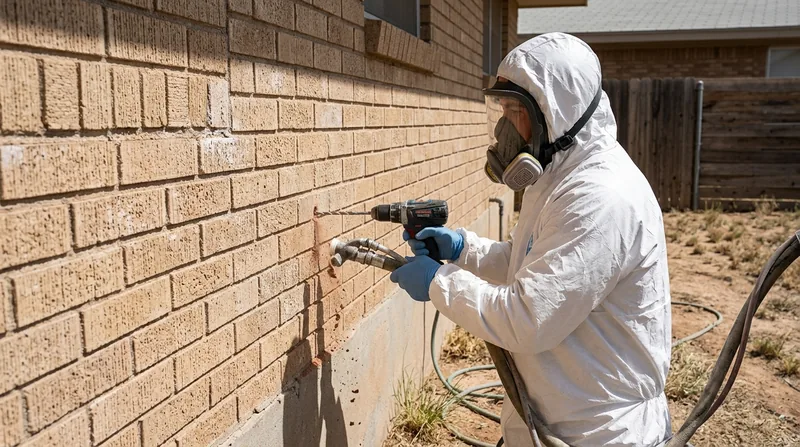




Brick ranches built across central Lubbock between the 1950s and 1970s often sit with wall cavities that were never insulated when construction finished. Those hollow spaces in exterior walls now leak air year-round, letting summer heat and winter cold push straight through plaster and brick, driving up heating and cooling costs while dust from West Texas wind finds its way inside. Wall and injection foam insulation solves this problem without tearing into your walls. We drill small holes, inject closed-cell or open-cell foam into the cavities, and seal them back up. The result is a draft-free wall, lower utility bills, and no major renovation. This approach works equally well for older frame houses near Texas Tech, metal-frame rental properties, and the newer slab-on-grade homes spreading south toward Wolfforth and Shallowater.
Why Wall and Injection Foam Insulation Matters in Lubbock's Climate
Lubbock sits on the flat South Plains in IECC climate zone 3B, where the real enemy is not moisture creeping through walls but heat and dust. Summer temperatures climb above 100 degrees for weeks at a time, and every uninsulated wall cavity acts as a thermal highway, pulling cool air from your air-conditioned interior straight to the outdoor heat. Winter cold snaps bring their own problems, with drafts around wall cavities and top plates letting heated air escape. Dust storms roll through regularly, and wind-driven air finds every gap in an uninsulated wall. Older homes like the brick ranches that define central Lubbock neighborhoods were built when energy costs were low and insulation standards were minimal. Many of these homes have zero insulation in their exterior walls. Injection foam fills those voids completely, sealing air leaks and adding real R-value without removing drywall or plaster.
- Injection foam reaches into wall cavities that blown-in insulation cannot, creating a continuous thermal and air barrier.
- The process requires only small drilled holes, leaving plaster, brick, and drywall intact so your home's exterior appearance does not change.
- Sealed walls reduce dust infiltration, a major quality-of-life issue in West Texas where wind-driven dust can coat furniture and trigger allergies.
- Closed-cell foam resists moisture and adds structural rigidity to walls, important in older homes where framing may have settled or moved.
When you combine wall injection with air sealing around windows, doors, and the rim joist, you stop the biggest sources of air leakage in a pre-1980 Lubbock home.
Key info: A brick ranch in central Lubbock with uninsulated 2x4 walls loses roughly 15 to 25 percent of its heating and cooling energy through those cavities. Injection foam can reduce that loss by up to 80 percent, depending on the foam type and the cavity depth.
How We Inject Foam Into Your Walls: The Process in Lubbock
Wall injection is straightforward and non-invasive. We locate the stud cavities, drill access holes from the exterior (usually 1 to 1.5 inches in diameter), and inject foam into each cavity from bottom to top, filling it completely. The holes are then plugged and patched to match your existing exterior. The whole job typically takes one day for an average home. We work from the outside whenever possible, so your interior is never disturbed. Before we start, we inspect the wall to confirm the cavities are dry and free of debris. If we find moisture, active leaks, or contamination, we stop and refer you to the right specialist. Foam does not fix a wet wall, and we will not spray over one.
- We identify stud locations using a stud finder and mark drilling points on the exterior.
- Holes are drilled at the bottom of each cavity so foam fills upward and air pockets are pushed out.
- Closed-cell or open-cell foam is injected at the correct pressure and speed to ensure complete fill without over-packing.
- Holes are sealed with foam-compatible plugs and caulk, then painted to blend with your brick or siding.
- We verify fill by checking foam density and monitoring injection pressure throughout the process.
The entire job is completed in a single visit, and mechanical ventilation during cure ensures safe air quality inside your home.
Local example: A 1,600-square-foot brick ranch in Lubbock's Monterey neighborhood with 2x4 exterior walls typically requires 40 to 60 access holes and 15 to 20 board feet of foam. The job takes 4 to 6 hours and costs between $800 and $1,200 depending on foam type and wall height.
Wall and Injection Foam Methods: Closed-Cell vs. Open-Cell
| Approach | Description | Best for |
|---|---|---|
| Closed-Cell Injection | High-density foam with closed cell structure, R-value 6 to 7 per inch, acts as an air and vapor barrier, resists moisture. | Older brick or frame homes where walls may have moisture risk or structural settling; homes in dusty areas where a vapor barrier is an asset. |
| Open-Cell Injection | Lower-density foam with open cell structure, R-value 3.5 to 4 per inch, allows vapor transmission, lighter footprint. | Newer homes with dry wall cavities and no moisture history; budget-conscious retrofits where R-value per dollar is the priority. |
| Hybrid or Partial Fill | Closed-cell foam injected to a set thickness (e.g., 1 to 2 inches) rather than filling the entire cavity, reducing cost. | Homeowners seeking meaningful R-value improvement without the expense of a complete fill; good balance of cost and performance. |
| Cavity Inspection and Prep | Borescope examination before injection to confirm cavity is dry, clear of debris, and suitable for foam. | Any injection job where doubt exists about cavity condition; prevents costly rework and ensures the foam bonds properly. |
Closed-cell is the standard choice in Lubbock because it handles dust infiltration better and provides a vapor barrier that protects older masonry from wind-driven moisture. Open-cell works well in newer homes where cavities are reliably dry and budget is the limiting factor. We recommend closed-cell for 90 percent of wall injection jobs in this region.
Wall and Injection Foam Insulation Cost in Lubbock: What to Expect
Wall injection foam typically starts at $2 per square foot of wall cavity and can run higher depending on foam type, cavity depth, and accessibility. For a 1,600-square-foot home with 2x4 exterior walls on two sides, the cost usually falls between $1,200 and $2,000. Closed-cell foam costs more than open-cell but delivers higher R-value and better moisture resistance, making it the standard for Lubbock's dry, dusty climate. Access matters: a home with easy exterior access and simple geometry costs less than one with complex rooflines, multiple additions, or brick that requires careful drilling. The number of cavities and the height of walls also factor in. A one-story ranch costs less than a two-story colonial with the same square footage.
The best way to understand cost for your home is to get a written estimate that includes the foam type, R-value per inch, total board feet, and the per-square-foot or per-cavity breakdown. Do not rely on phone quotes. We provide free, no-obligation estimates within 24 hours at (806) 853-5452. See our full pricing overview for typical ranges and what factors move the cost up or down.
Wall and Injection Foam Insulation Near Me: What Lubbock Homeowners Should Know Before Hiring
When you hire any spray foam contractor for wall injection, verify that they are fully insured and can provide a certificate of insurance naming your address. Texas does not issue a state license for spray foam insulation, but contractor registration requirements vary by city. Lubbock, Wolfforth, Shallowater, and other cities in Greater Lubbock may have their own registration or permitting rules. Before work begins, ask your contractor whether a permit is required at your address and confirm they understand what your city or county requires. A reputable contractor will be transparent about this and will help you navigate it.
- Request at least two or three written estimates that specify foam type, R-value, thickness, and total board feet.
- Ask whether the contractor will inspect the wall cavity before injection and what they do if moisture or contamination is found.
- Confirm that mechanical ventilation will be used during cure and ask about the re-entry window (typically 24 to 48 hours).
- Check that the estimate includes the cost of patching and painting the access holes to match your exterior.
- Verify the warranty on workmanship (usually one to three years) and understand what it covers.
- If your home is in an HOA or master-planned community, confirm whether exterior work requires architectural approval before drilling begins.
A low estimate with no R-value specs, no mention of cavity inspection, and a promise of immediate re-entry is a red flag. The same goes for a contractor who cannot verify their insurance or who offers a price far below market. Contact us for a free estimate and to discuss your specific wall and home.
Wall & Injection Foam Insulation in Lubbock: Pricing Guide
| Service | Price | Details |
|---|---|---|
| Wall Injection Foam (Closed-Cell) | Starting at $2/sq ft | High-density closed-cell foam for superior air sealing and dust resistance in older Lubbock masonry and frame homes |
| Wall Injection Foam (Open-Cell) | Starting at $1.50/sq ft | Lower-cost open-cell option for dry cavities and newer construction where budget takes priority over vapor barrier |
| Cavity Inspection and Borescope Survey | Included in estimate | Pre-injection inspection to confirm cavity is dry and clear of debris, preventing costly rework and ensuring proper foam bond |
| Patching and Paint Match | Included | Access holes are sealed, caulked, and painted to blend with existing brick, siding, or plaster exterior finish |
| Travel and Estimate | Free | No charge for site visit or written estimate within Lubbock and surrounding service areas, response within 24 hours |
Indicative pricing, the exact cost depends on square footage, finish, and site access. Free personalized estimate within 24h at (806) 853-5452.


